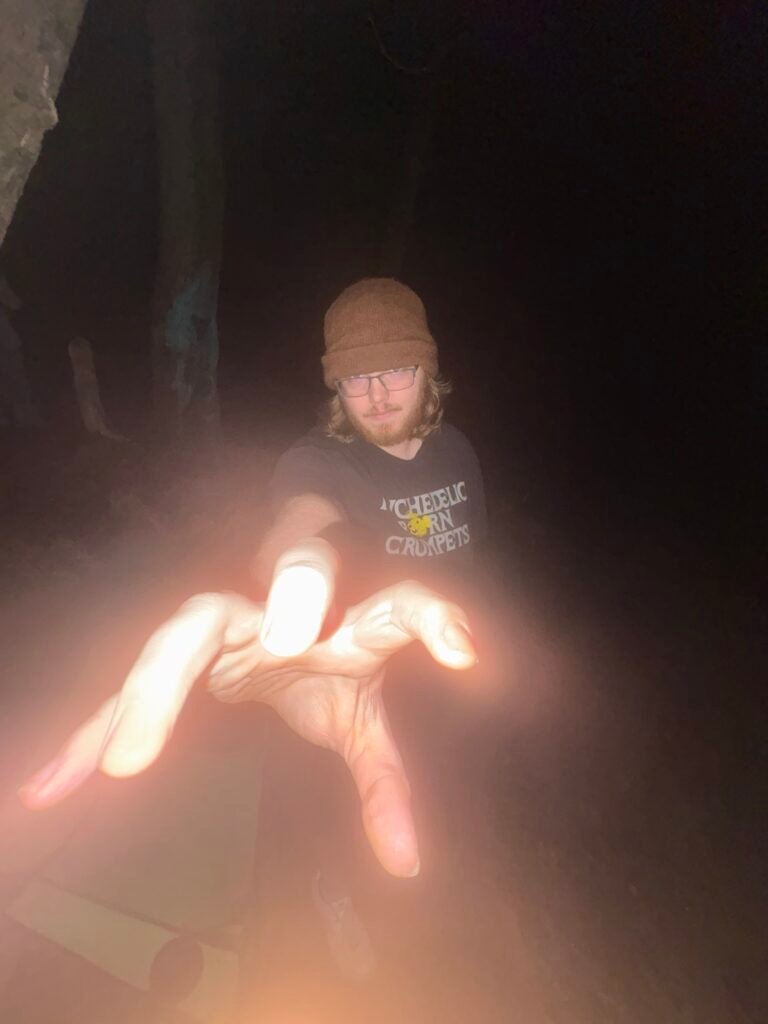
Logan McGranahan is a senior at SUNY Fredonia studying music composition, and he has released two full self-produced albums, an EP, and a handful of singles in just two years. Glass Desk Thoughts came first, a collection of instrumental electronic work he built on GarageBand on an iPad going back to high school. Everlost followed, his first record with vocals, and provided a very impressive showcase of vocal ability as well as lyrical prowess. He is also the lead singer of New Venice, a band made up of his friends and roommates. His third album, Wildfires, is in progress.
On paper that sounds like a lot. In practice it is, and he will be the first to tell you that.
What I found interesting about Logan before we even sat down is that his music does not sound like the work of someone trying to figure out what they are. It sounds like the work of someone who knows exactly what they want to say and is still learning how to say it at full volume. There is a difference there, and it matters. Everlost is emotionally heavy in a way that feels deliberate, not accidental. The songs are long because he wants them to be. The subject matter is dark because that is what he is working through.
He is also, in person, genuinely funny and not particularly scared to show his goofy side.
Logan currently sits well under 100k monthly listeners on Spotify. He estimates his fanbase at maybe thirty people, and he said that with a straight face. I think that number is going to change. But that is not really the point of this piece. The point is that the work is already worth paying attention to, and right now is exactly the right time to do it.
Q: Looking back at Glass Desk Thoughts and Everlost now, how do you actually feel about them?
A: I was a developing artist at the time, and I still am. Some of it was good, some not so much, but I don’t regret any of it. It’s like asking a guitarist who’s been playing for 20 years how they feel about how they played ten years ago. They’re probably going to say no. But do I still respect them as projects? Yes. Do I regret them? No.
Q: Your SoundCloud is still out there. Hitman with three N’s and an E. When you go back and hear those early demos, what goes through your head?
A: I was having fun, and I still am. You can obviously see how much my music has grown since then, but I’m never going to get rid of the SoundCloud. It’s a nice little niche thing. If I ever somehow blow up, people are going to discover it on their own and be like, this is how this guy started.
Q: Walk me through what balancing all of this actually looks like. Full time student, solo project, leading a band, still being a person.
A: Not organized, I’ll be honest. It’s a lot on me mentally and physically. I get maybe two hours every two days to relax, and that’s usually filled with homework. New Venice rehearses twice a week, not even counting shows. I try to work on the album twice a week, and school is just full time on top of that. I don’t sleep enough. But Tower of Babel wasn’t built in a day.
Q: Do you experience burnout?
A: All the time. I try to manage it, take some time to myself, but usually that comes at the sacrifice of schoolwork. I don’t like to parade it around because I just sound like a broken record. But I can’t act miserable in front of my band. We believe in leaving shit at the door. If I truly acted how I wanted to act all the time, everyone would have quit by now.
Q: What does making music with your roommates in New Venice look like compared to working alone? Do you ever genuinely disagree creatively?
A: All the time, and that’s kind of the whole process. When we have two contrasting ideas we just try both of them, and that usually determines what prevails. As for working alone versus the band, I can bang out two songs in a three hour session on my own. With a band it just takes more time by nature. But they’re so different that I like tapping into both. New Venice is a metal band and my solo stuff is electronic. It’s a nice contrast.
Q: You went from producing everything on GarageBand on an iPad to Logic on a MacBook. What has that jump been like?
A: GarageBand is very user friendly. Lots of shapes and colors, you know. Logic took me about three months to fully figure out, but once I got it, there is so much more it has to offer in terms of mixing, plugins, capabilities. GarageBand was a great limitation to test what I could do with free software. Now I feel like I can actually compose to my full ability.
Q: Why are your songs so long?
A: It is hard for me to write short songs, and I’m trying to get better at it. But I was raised on classical and jazz, and if you’re familiar, those are not known for their brevity. I have so many ideas I want to fit into each song, and compressing that into two or three minutes just sounds rushed. I’m just not good at that at the moment.
Q: Your solo music is pretty emotionally heavy, but in person you clearly don’t take yourself too seriously. How do those two versions of you coexist?
A: The music is a side of me I don’t typically show in person. We all suffer, and to suffer is to live, but I have two outlets that help me get through whatever I deal with. My friends, who I’m very emotionally vulnerable with, and my music. Both are my therapy. The thing is, I don’t write with my emotions. I write what I am feeling. There’s a difference between letting your emotions dictate what you write and actually articulating what you felt from a clear headspace. Because I’m so open about heavy subject matter in my music, I’ve been able to emotionally mature to a point where I’ve found healthy coping mechanisms. Music is one of them.
Q: What are your plans for Wildfires, both musically and conceptually?
A: Musically, I’m getting a lot more experimental. Electronic is still the base, but I’m adding new instruments, playing guitar, doing weird things with mixing. This one kind of blows everything I’ve done before out of the water, I think. Conceptually, it’s a concept album about mental health. It’s supposed to bring you off the ledge. The first half is dark, you’re in a terrible place, but the second half you slowly start to grow and heal. If you make it all the way through, it’s actually a hopeful album. It tells you to hold on. And I leave it off acknowledging that even though this too shall pass, life ebbs and flows. But you will always find a way to dig yourself out.
Q: What was the idea behind “We Used to Kill Nazis?”
A: We are living in a fascist society right now, and honestly we have been for a long time. It’s just been slowly revealing itself more and more. What specifically motivated it was activities night. There was a Turning Point USA table drawing a lot of attention, and I went over trying to pull people away because giving TPUSA attention is just want they want. The chief of university police threatened to arrest me just for that. I went home pissed off, and I wrote that song channeling all of it. It’s a true statement. We used to kill Nazis. We fought a whole world war and kicked their ass, and we knew it was the right thing to do. I don’t know what happened.
Q: Do you think artists have a responsibility to speak on political things?
A: I don’t think artists have to. That’s up to them. But if you are living on this earth, you are a part of politics. You can’t escape it. Both sides are deeply corrupt, but at the end of the day there’s having empathy and there’s not. When a side is actively dehumanizing people and stripping them of rights, refusing to speak on that either means you’re afraid or we already know where you stand and you’re just too afraid to say it.
Q: Do you actually want to be mainstream, or is there something you’d lose in that?
A: I think it’s a little pretentious to say art loses its value when it goes mainstream. Just because you go mainstream doesn’t mean you have to go corporate. You shouldn’t have to water it down for a couple of industry airheads. I would love for that many people to like what I do. But I’m not hell bent on it either. My music is different, and I know it can be a hard listen for a mainstream audience. If it happens, great. If not, I understand
Q: You mentioned wanting to move to New York and write music for video games. Is that still the plan?
A: Plans have changed. We are actually going to try to move to Buffalo and make New Venice a professional band. I don’t know how long that window is, but we’ve agreed to give it a real shot. If we can get to a level where we’re playing shows consistently and building a following that lets us make ends meet, that’s the dream. Being in that band is the most fun I’ve had in my life. Everything else is secondary right now.
Q: Has there been a moment where you realized people outside your immediate circle were actually listening?
A: A few people I’ve never seen in my life have come up to me on campus and said they love my solo stuff. I don’t have a huge fanbase, maybe thirty people at most, and that might even be stretching it. But my music is different, and it can be a hard listen. So when someone outside my immediate circle takes the chance on it and actually connects with it, that means a lot.
Q: What would you tell a college student who wants to start making music but hasn’t yet?
A: Do it. It took me until sophomore year to get the courage to actually release my own stuff, but it felt good when I did. Start with the free software. GarageBand is a real stepping stone. Also, use the SRT majors. They are there for you, they are incredibly talented, and they usually work for free because they need the experience. The other barrier is your voice. It took me until my second album to try singing, and it was terrifying. But singing is literally a muscular thing. The more you do it, the stronger your vocal cords get. Just get it out there. Regardless of what you think, it has a huge payoff. Who knows where it might lead you